
A Guide for First-Time Tenants
Leasing commercial space for your business can be both exciting and overwhelming, especially if it is your first time navigating a lease agreement. At Shophouse Properties, we believe in transparency and want to equip our tenants with the knowledge they need to make confident decisions. Understanding the standard terms used in commercial leasing is an important first step.
Below is a breakdown of key leasing terms that will help you better understand what to expect when reviewing a lease or discussing terms with a landlord or broker.
Base Rent
Base rent is the fixed minimum amount you pay each month to lease a space. It is typically calculated per square foot per year. For example, if the lease rate is $20.00 per square foot annually for a 1,300 square foot space, your total yearly rent is $26,000, or approximately $2,166.67 per month. This amount does not include additional charges like property taxes, insurance, or common area maintenance fees.
Common Area Maintenance (CAM)
CAM fees cover the landlord’s cost to maintain shared areas of the property that are not leased to any one tenant. These costs may include landscaping, snow removal, utilities, parking lot maintenance, and other expenses related to the upkeep of communal spaces.
General Liability Insurance
This is a comprehensive insurance policy that protects your business from various liability exposures such as bodily injury, property damage, and other risks that may arise during normal operations. It is separate from property insurance, which is typically handled by the landlord.
Property Insurance
While tenants carry their own general liability insurance, landlords may require tenants to pay a prorated share of the building’s insurance costs. These charges are typically included in what is known as triple net (NNN) expenses.
Property Taxes
Tenants are often responsible for their share of property taxes, which are also typically included in NNN fees.
Triple Net (NNN)
NNN refers to additional costs that tenants pay on top of base rent. These include property taxes, insurance, and CAM fees. These costs are shared among all tenants based on the size of the space they occupy.
Gross Leasable Area (GLA)
This is the square footage of the space as defined by the Building Owners and Managers Association (BOMA). For retail spaces, it is measured from the center of shared walls between tenants to the outside face of exterior walls.
Letter of Intent (LOI)
A Letter of Intent is a non-binding document that outlines your proposed terms for leasing a space. It acts as a starting point for negotiations with the landlord and helps both parties begin discussions with clarity.
Lease
The lease is the legal contract that outlines all terms and conditions of your rental agreement. These documents are typically 15 to 30 pages and often cover a lease term of three to ten years. It is strongly recommended that you have a real estate attorney review the lease before signing.
Possession Date vs. Rent Commencement Date
The possession date is when you gain access to the space. The rent commencement date is when your rent payments begin. These dates are often different, especially if you need time to build out or prepare your space before opening.
Tenant Improvement Allowance (TIA or TI)
This is a set amount, often calculated per square foot, that the landlord provides to help you renovate or build out your space. This allowance is typically paid after you begin operations.
Landlord Work
This includes any improvements or repairs the landlord agrees to complete before the tenant moves in. It may involve structural repairs, utility installation, or other preparations specified in the lease.
Guaranty
If the lease is signed under a business entity, landlords may request a personal guaranty. This makes an individual personally responsible for the lease if the business cannot meet its obligations.
Landlord
In a commercial lease, the landlord is the individual or entity that owns and leases property for business use, such as retail, office, or restaurant space.
Tenant
The tenant is the legal entity that rents the commercial space. This could be an LLC, corporation, or other legal business structure.
At Shophouse Properties, we work with independent business owners who want more than just a space. We believe in helping you create places that matter in the communities you live and serve. Whether you are leasing your first retail store or expanding your local brand, we are here to walk with you through every step of the leasing process.
For more leasing resources or to view available spaces, visit shophouseprop.com/our-properties
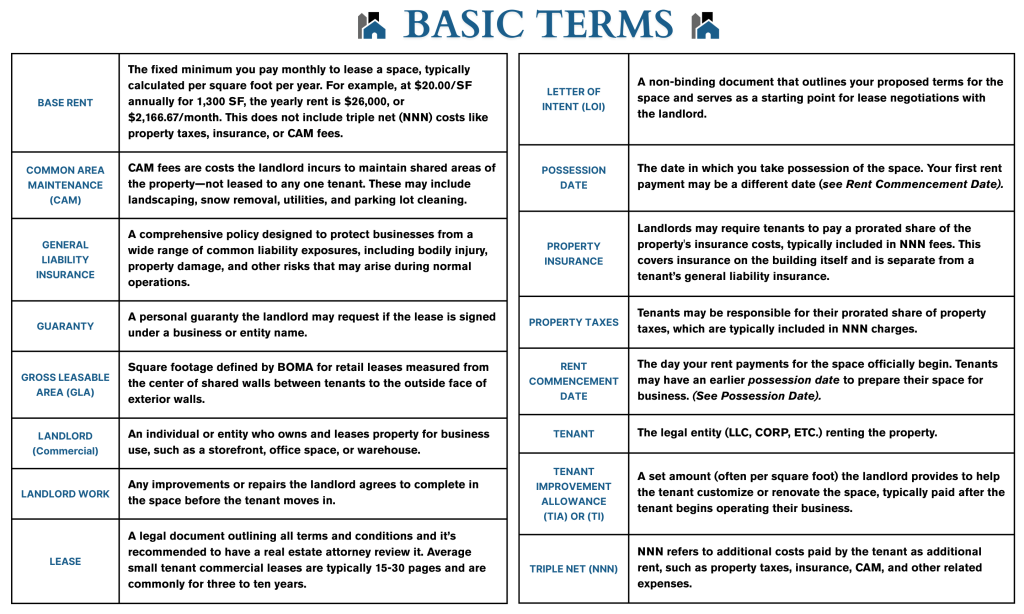
Save this image for more information on basic terms and for your future use!
 Shophouse Properties
Leave a comment